
08/06/2026 by Dr. Goldi Jacques-Maynes
Why Your Back Hurts During Pregnancy—It's Not Just the Baby's Weight
Most moms expect a little low back discomfort as their baby grows.
What often surprises them is how much that discomfort affects everyday life.
Back pain can really throw off your daily rhythm.
And back pain is one of the most common complaints during pregnancy.
It can look like this:
- Rolling over in bed suddenly hurts
- Standing up from the couch takes extra effort
- Walking through the grocery store leaves your back aching
- Getting in and out of the car needs to be a carefully planned maneuver
Is this just how pregnancy is? Yes, and No.
While pregnancy places new demands on your body, you don't have to simply suffer through months of back pain.
Understanding why your back hurts is the first step toward helping it feel better.
Why pregnancy puts so much stress on your low back:
Pregnancy asks your body to adapt in many incredible ways.
As your baby grows, your muscles, joints, and ligaments are constantly adjusting to support both you and your baby.
There are several normal pregnancy-related changes that can contribute to your low back pain, for instance:
Your body becomes more flexible for birth.
During pregnancy, your body produces hormones that soften and loosen your ligaments so your pelvis can prepare for delivery.
This is exactly what your body is supposed to do—but looser joints can also feel less stable.
As your body works to compensate, the joints in your lower back and pelvis can become irritated, especially when you're standing, walking, or rolling over in bed.
Your center of gravity keeps changing.
As your uterus grows, your center of gravity shifts forward.
Your lower back naturally arches a little more to help keep you balanced.
At the same time, your abdominal muscles stretch and have a harder time supporting your spine.
That means your low back, hips, and pelvis often end up doing more work than they're designed to handle.
Your muscles start working overtime.
Your body is incredibly smart.
When one area becomes less stable, other muscles step in to help.
The muscles around your low back, hips, and pelvis often tighten as they try to protect your joints and keep you moving.
Over time, those overworked muscles can become sore, fatigued, and stiff.
That's why many moms notice their back pain is worse after:
- Standing for long periods
- Walking longer distances
- Climbing stairs
- Carrying another child
- Rolling over in bed
Your back pain isn't always coming from your back.
One thing I explain to many pregnant patients is that the area hurting isn't always the true source of the problem.
Many women point to their low back, but the irritation is often coming from the sacrum or sacroiliac (SI) joints, where your spine meets your pelvis.
When these joints aren't moving comfortably—or the muscles around them become tight and protective—you may feel a deep ache across your low back, near your tailbone, or into one side of your buttock.
The little things you do every day matter.
One of the biggest surprises for many moms is how much small daily habits affect their back pain.
How you perform some daily movements can make your pain better, or worse:
The way you roll over in bed.
How you get into the car.
How you stand while making dinner.
How you pick up your toddler.
These small movements add up over the course of a day.
I like to talk with my patients about simple strategies that help reduce unnecessary strain on the back and pelvis.
They're often small changes, but my patients are frequently amazed by how much better they feel once they start moving in ways that better support their changing bodies.
Gentle movement and adjustments really can help.
Helping your body adapt for less strain and more ease is a big focus of my work with pregnant patients.
Every body is different, though, so every treatment plan is different.
Depending on what your body needs, your care plan may include:
- Gentle chiropractic adjustments
- Craniosacral/Myofascial release
- Spinning Babies® techniques
- Personalized movement and posture recommendations
These approaches work together to:
- Improve movement in the joints of your spine and pelvis
- Reduce tension in overworked muscles
- Help your body move more comfortably
- Create better balance throughout your pelvis
- Support a more comfortable pregnancy as your baby grows
One of my favorite parts of caring for pregnant patients is helping them understand why they're hurting—and giving them simple tools that help them feel better between visits.
Gentle exercises for pregnancy-related back pain can also help.
I often recommend simple movement as part of a personalized care plan for my prenatal patients.
These exercises can help improve mobility, reduce tension, support your changing body, and create more comfort throughout pregnancy.
Important: Before trying any of these exercises, be sure to check with your trusted prenatal healthcare provider.
If your low back feels compressed or stiff:
The Standing Figure 8 is one of my favorite gentle mobility exercises.
It encourages your pelvis to move naturally, helps reduce low back tension, and supports your body's changing mechanics throughout pregnancy.
Watch the Standing Figure 8 video.
If your sacrum or tailbone feels achy:
The Standing Sacral Release helps ease tension around the sacrum, hips, and tailbone while encouraging relaxation throughout the pelvis.
Watch the Standing Sacral Release video.
If your back aches after standing or walking:
Dip the Hip helps reduce pressure through the low back and sacrum while gently loosening the surrounding ligaments and creating more room for your baby.
If Dip the Hip isn't comfortable for you:
Every pregnancy is different. That's why I also recommend a modified version that provides similar benefits while being more comfortable for some moms.
Watch the Dip the Hip Modification video.
If you need a little extra support throughout the day:
Sometimes your muscles simply need a little help.
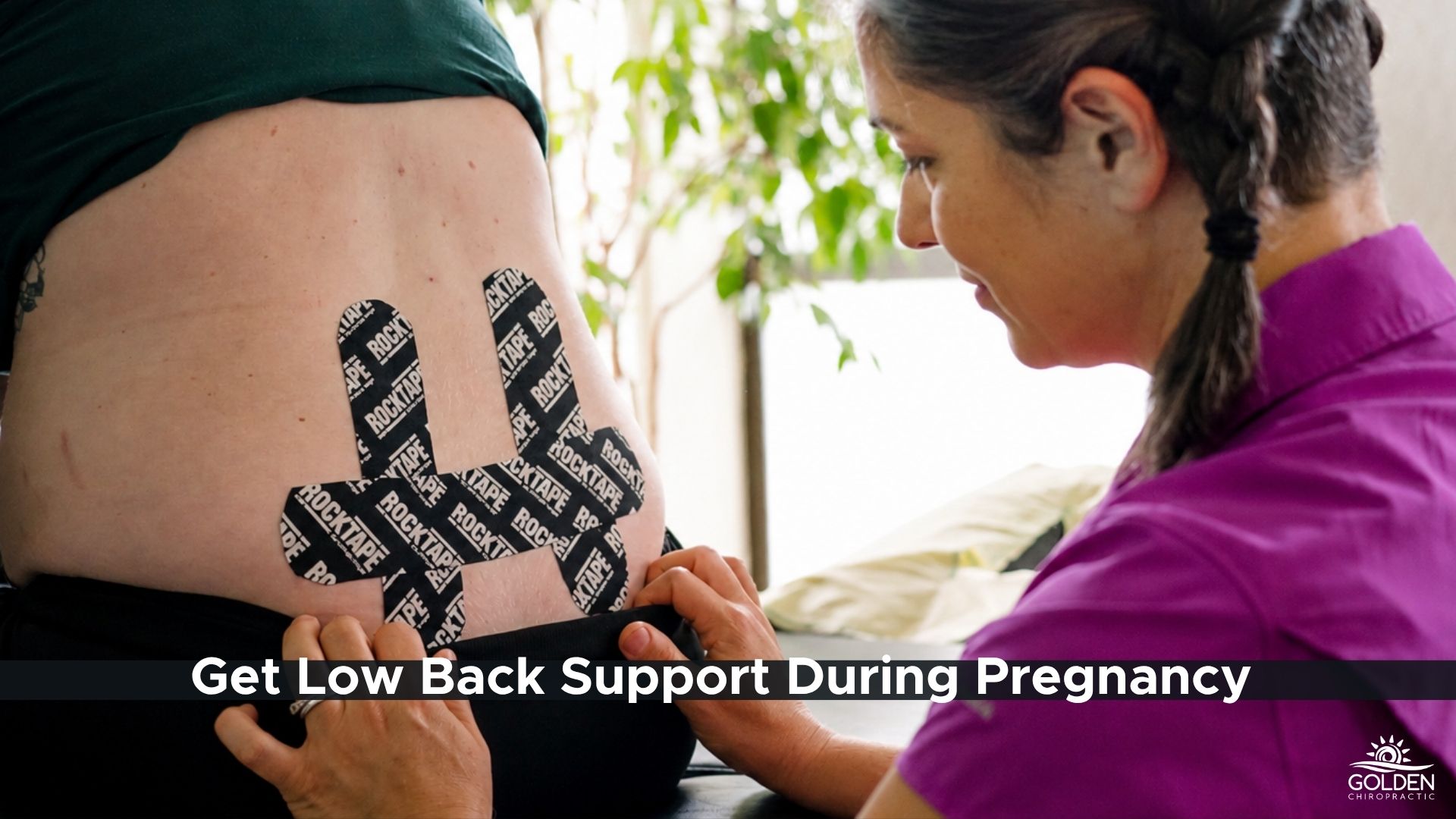
H-Tape for Low Back Support provides gentle support that can reduce strain on your low back and improve comfort while you're moving through your day.
Watch the H-Tape for Low Back Support video.
My patients often report that the above exercises really DO help them with their low back pain and discomfort.
But, I always advise having the best exercises for YOU be recommended by a trained professional.
Also, there’s another point I’d like pregnant people to keep in mind:
Sometimes pregnancy-related back pain needs prompt medical attention.
Most pregnancy-related back pain is mechanical, meaning it's related to the normal changes happening in your body.
However, you should contact your OB, midwife, or healthcare provider right away if you experience:
- New numbness, tingling, or weakness in a leg
- Loss of bowel or bladder control
- Severe, constant pain that doesn't improve with rest
- Fever along with back pain
- Back pain after a significant fall or injury
These symptoms may indicate a condition that needs prompt medical evaluation.
I know, that was a bit scary, but I want my pregnant patients to be sure to seek the care they need, when they need it.
If you're in pain, or feeling really, really uncomfortable, please get help.
You don't have to "just live with” low back pain when you’re pregnant.
Some discomfort is normal.
But struggling through every day isn't something you simply have to accept.
You can move through pregnancy with more comfort, confidence, and trust in your body.
Whether you're newly pregnant or counting down the weeks until you meet your baby, I'd love to help you feel more supported along the way.
If pregnancy-related back pain is making it harder to enjoy this special season, we're here to help.
Our chiropractors provide gentle, personalized prenatal chiropractic care in Aptos, along with movement coaching and supportive therapies.
Schedule online today, we can help you have a more comfortable pregnancy.