
06/11/2026 by Dr. Joe Bell
Rotator Cuff Tendonitis: Too Much Load on the Shoulder
Ever reach into a cabinet and suddenly notice a sharp pain in your shoulder?
Maybe it only hurts when you lift your arm overhead.
Maybe sleeping on that side has started waking you up at night.
Or maybe you've noticed yourself avoiding certain movements because you already know they're going to hurt.
That's often how rotator cuff tendonitis starts talking to you.
One of the biggest problems with rotator cuff tendonitis is that it usually doesn't seem like a big deal at first.
For many people, it starts as a minor annoyance during workouts, yard work, or reaching overhead at work.
The pain comes and goes.
And you can still do most of the things you need to do.
So it's easy to ignore.
But over time, that irritation can become more consistent.
What once only hurt during exercise now hurts when getting dressed.
Reaching into the pantry hurts.
Sleeping becomes uncomfortable.
Eventually, many people find themselves thinking about their shoulder all day long.
That’s how rotator cuff tendonitis develops if you keep ignoring the pain and discomfort.
When the load on your shoulder becomes too much, your shoulder lets you know.
The rotator cuff is made up of four muscles that help stabilize and move your shoulder joint.
The tendons connecting these muscles to bone help create movement every time you lift, reach, throw, push, or pull.
You’re basically using your rotator cuff all day, everyday.
The vast majority of rotator cuff tendonitis cases develop from overuse.
Your shoulder is simply being asked to do more than the rotator cuff can comfortably manage.
When that happens, the tendons become irritated.
And irritated tendons tend to ask for your attention.
At this stage, most people assume that their shoulder pain will simply work itself out.
Sometimes it does.
But many cases of rotator cuff tendonitis follow a different pattern.
The irritation sticks around.
The shoulder starts feeling stiff.
Pain shows up more often.
And eventually, these simple activities become painful and frustrating:
- Returning dishes to an overhead cabinet
- Throwing a ball
- Swimming or paddling
- Weight training
- Doing manual labor
Most people notice these symptoms first:
- Pain when reaching overhead
- Pain reaching away from the body
- Pain putting on a shirt or jacket
- Pain sleeping on the affected side
- A dull, achy feeling in the shoulder
- Sharp pain with certain movements
- Weakness during lifting or reaching
Rotator cuff tendonitis can happen at almost any age.
For younger patients, it often develops after repetitive activity, sports participation, heavy lifting, or an injury.
For older adults, it is commonly associated with years of use, age-related changes within the shoulder, and gradual degeneration of the tendon.
We commonly see rotator cuff tendonitis in people who:
- Play pickleball, tennis, golf, or other recreational sports
- Swim regularly
- Lift weights
- Work physically demanding jobs
- Perform repetitive overhead tasks
- Stay active as they age
No matter what’s causing it, no one wants to be limited by shoulder pain.
The degree to which your life will be limited by rotator cuff tendonitis depends on the cause and how soon you get help.
If you're starting to notice issues with your shoulder, get evaluated sooner rather than later.
The longer you tolerate shoulder pain or discomfort, the worse it could become.
What happens if you ignore the symptoms of rotator cuff tendonitis?
This is one of those conditions that often starts out feeling manageable.
But that doesn't mean it's getting better.
Here's what we typically see:
- The tendon becomes more irritated
- Pain begins showing up during lighter activities
- Sleep becomes more disrupted
- Shoulder mobility decreases
- Strength starts to decline
- Compensation patterns develop in the neck and upper back
One of our most common findings is that the shoulder isn't the only thing that's hurting.
The neck becomes tight.
The upper trapezius starts working overtime.
The muscles around the shoulder blade become stiff and restricted.
Your body is trying to protect the irritated shoulder.
Unfortunately, those compensation patterns often create new problems.
If you're noticing any of the symptoms below, it's worth getting checked out:
- Pain lasting more than a few weeks
- Symptoms that are progressively worsening
- Pain that regularly wakes you at night
- Noticeable weakness
- Difficulty performing everyday activities
- Shoulder pain following a fall or injury
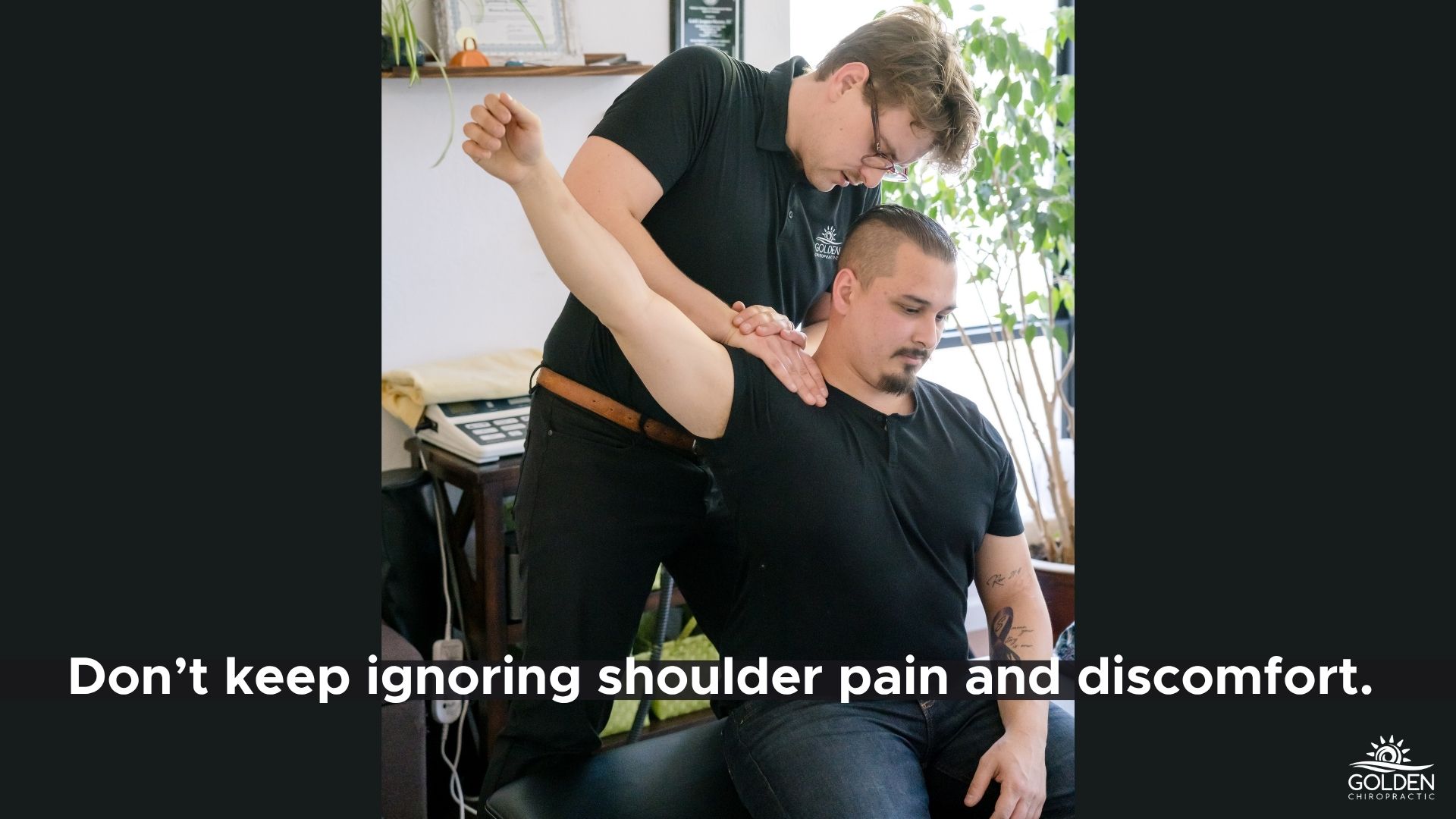
As chiropractors, how do we manage rotator cuff tendonitis?
Our first goal is to figure out why the tendon became overloaded in the first place.
During your evaluation, we'll look at:
- Shoulder mobility
- Rotator cuff strength
- Movement patterns
- Areas of compensation
- How the neck and upper back are contributing to shoulder function
We often find that the irritated tendon isn't the only issue.
A stiff upper back can limit overhead motion and increase strain on your shoulder.
Tight pec muscles can pull your shoulders forward and reduce space in your shoulder joint.
Neck tension can contribute to altered shoulder mechanics.
Weak shoulder blade stabilizers can force your rotator cuff to work harder than it should.
By looking at the entire system, we can help identify the root cause of the problem rather than simply chasing symptoms.
From there, we build a treatment plan designed to improve shoulder function, reduce irritation, and help you return to the activities you enjoy.
Once we start addressing the right things, patients often notice:
- Less pain reaching overhead
- Better sleep
- Improved shoulder mobility
- Greater confidence in movement
One of my favorite moments is when patients stop thinking about their shoulder all day long.
That's usually when we know we're moving in the right direction.
Does rotator cuff tendonitis ever require surgery?
Thankfully, most people we see with rotator cuff tendonitis do not need surgery.
The majority of cases involve irritation of the tendon rather than a complete tear.
And when it’s just a matter of irritation, we can help—a lot!
We can help you improve shoulder mechanics, reduce irritation, restore mobility, and gradually rebuild strength.
Many patients are able to return to normal activities without surgical intervention.
But that doesn't mean healing happens overnight.
Tendons generally recover more slowly than muscles.
They need time, consistency, and appropriate loading to heal well.
When might surgery be necessary?
There are situations where a surgical consultation may be appropriate.
Examples include:
- Full-thickness rotator cuff tears
- Significant weakness after an injury
- Loss of shoulder function that continues to worsen
- Symptoms that fail to improve despite dedicated rehabilitation
- Traumatic injuries involving a fall or direct impact
If we suspect something more serious is happening, we'll tell you.
Our goal is to help you understand what's going on, what your options are, and whether conservative care is the right place to start.
What can you do at home to ease the strain on your rotator cuff?
If you're dealing with early symptoms, these exercises may help reduce tension and improve mobility:
Upper Back Progression One: Mobilization
- Upper Trapezius Mobilization
- Position Lacrosse Ball between door frame and the upper trapezius
- Work across entire muscle of shoulder to base of the neck
- Drive into ball and move your arm behind your back to further mobilize
- Levator Scapulae Mobilization
- Position Lacrosse Ball at corner of shoulder blade while laying on back
- Elevate Hips to add pressure
- Add arm movement up to the ceiling to further mobilize
- Rhomboid Mobilization
- Position Lacrosse Ball between shoulder blade and spine
- Lift up head to further add pressure
- Add arm movement across the body to further mobilize
Upper Back Progression Two: Stretching
- Pectoral Stretch
- Position your arm to 90°
- Bring forearm against door frame
- Step forward until you feel slight stretch in chest
- To further stretch pectoral muscles, move arm to a slightly higher position
- Upper Trapezius Stretch
- Position affected-side arm behind back
- Use unaffected arm to pull head towards opposite shoulder
- Levator Scapulae Stretch
- Take affected-side arm and sit on hand to fully depress the scapula
- Use other hand to pull head down at an angle looking at opposite side hip
The goal is to move smarter while allowing the irritated tendon an opportunity to recover.
Your shoulder was designed to move.
Helping it move well again is often one of the most important parts of recovery.
Teaching you how to move safely to encourage faster healing is a big part of what we do.
If shoulder pain is limiting your workouts, disrupting your sleep, or making everyday activities more difficult, don't wait for it to become a bigger problem.
Finding the root cause of your shoulder pain is the best way to get back to doing the things you love.
You can schedule online anytime to visit our chiropractors in Aptos.
We're here to help you move comfortably, confidently, and without constantly worrying about your shoulder.