
02/26/2026 by Dr. Goldi Jacques-Maynes
Relief from the Stress of Plagiocephaly
Not too long ago, an exhausted, worried mama came in with her 10-day-old newborn.
Her son’s birth had been traumatic, and she was having some concerns:
- The baby had birth-related cranial remodeling
- He also exhibited poor feeding, and a lack of weight gain
- His latch was shallow
Mom heard that Cranial Sacral Therapy and chiropractic might help.
That's what brought her in.
After one visit—and because she followed her home care instructions—the baby’s feeding improved, and Mama began to feel relieved.
Over time, together, we were able to address all of her newborn’s symptoms.
You may be wondering why the baby’s symptoms all came together.
What does birth trauma have to do with a flat spot?
What does a baby’s head shape have to do with the way he feeds?
I’lll explain.
We’ll start with what exactly plagiocephaly is, and how it happens.
Plagiocephaly is a flattening on one part of the baby’s skull.
It’s commonly called “flat head syndrome.”
A baby’s soft skull becomes flattened on one side or the back due to repeated, consistent pressure.
Plagiocephaly can come from:
- Birth tension
- Head remodeling in utero from fetal positioning
- Sleeping on their back
- Prolonged time in car seats or swings
- Torticollis (a crick in the neck)
Birth is intense on a tiny body.
During birth, your baby’s head, neck, and spine experience compression, twisting forces, rotational stress, skull molding, and intense nervous system stimulation.
A baby’s head is meant to be moldable. That flexibility helps them move through the birth canal.
Usually, the molding during birth resolves naturally.
But sometimes tension patterns don’t unwind.
Things like:
- Induction
- Prolonged pushing
- Vacuum extraction
- Forceps
- Breech positioning
- C-section
… can make birth harder on the baby and affect cranial molding.
Most parents don’t come in saying “my baby has plagiocephaly.”
They say:
“Their head looks a little flat on one side.”
“One eye looks more squished.”
“Their forehead sticks out more on one side.”
“They always turn their head to the right.”
“They hate feeding on one breast.”
These poor parents struggle with so much exhaustion, overwhelm and worry. They stress out wondering, ”What if my baby’s head won’t round out on its own?”
But it’s not just the head shape that’s the problem.
Cranial distortion isn’t just cosmetic.
A baby’s head shape can affect their feeding, sleep, and comfort.
Plagiocephaly can affect:
- The soft palate inside the mouth
- Suck pattern
- Neck rotation
- Jaw comfort
- Nervous system regulation
If a baby can’t comfortably turn their head, they may prefer one breast.
If their cranial bones are under tension, feeding can feel inefficient or frustrating.
If their nervous system is stressed, they may cry.
A baby can’t tell you they have a headache, that they’re stressed, or frustrated trying to feed.
So they cry.
And a postpartum mom is already exhausted.
She may leave the baby in the swing longer because it’s the only thing keeping them calm.
Then the pattern reinforces itself.
Exhausted parents need a break, and no one is blaming you for putting your infant down for a while.
Parents need rest, too. A lot of it.
The solution comes from understanding and working with your baby’s body mechanics.
Together we can help your baby’s body do what it’s naturally meant to do.
Gentle adjustments + home exercises are what work.
A six-month-old infant came to me with significant plagiocephaly from torticollis.
She always kept her head turned to the right.
She had:
- A significant flat spot
- Limited improvement with pediatric physical therapy
- Been fitted for a cranial remolding helmet
She hated the helmet. She cried every time it went on.
I did four gentle treatments.
I gave the parents home exercises to support what we were doing in the office.
The parents were diligent about doing the exercises, and that’s what really helped.
Within a few weeks, the baby’s bone structure improved significantly.
It had been a month since her last visit, as I had been out on medical leave.
The parents were worried that the baby’s progress had stalled.
But it hadn’t.
The home care they were doing had helped so much.
This is the part I love most: Parents are not powerless against plagiocephaly.
They just need the right guidance on gentle exercises for their baby.
What I actually do during an infant visit:
First, I listen to parent’s observations, daily routines, and worries.
Then I check:
- How baby holds their head
- Tension in the skull, jaw, neck, and spine
- Cranial motion
- Feeding mechanics
- Overall nervous system tone
From my observations, I decide on the best approach to treatment.
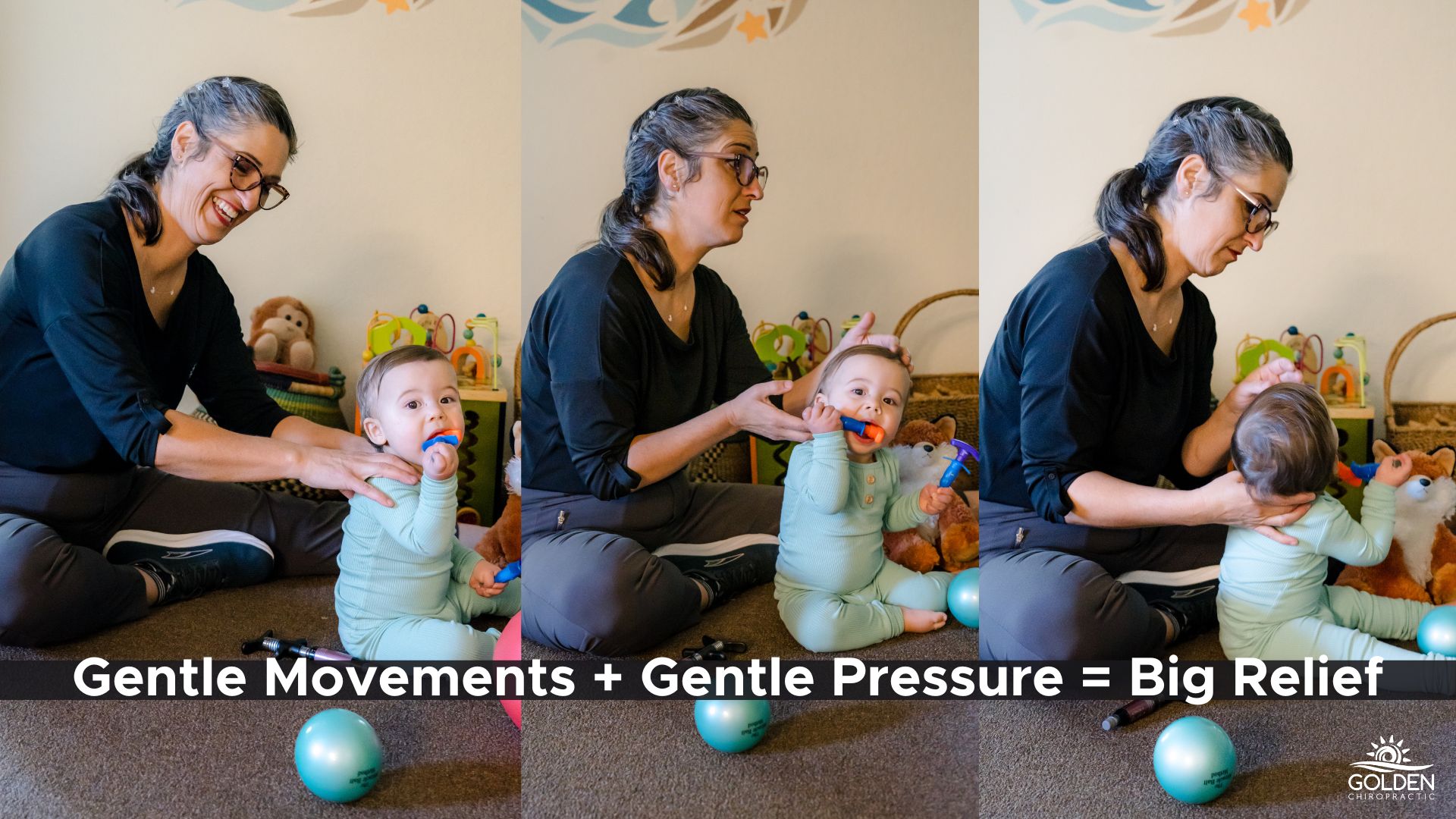
Infant adjustments are incredibly gentle. Think contact lens pressure.
I use gentle cranial work to encourage motion in the skull bones. Remember—their heads are meant to be moldable at this stage.
I release tension.
I guide better movement patterns.
And I educate parents on positioning and balancing time between lying down, being held, and upright activity.
We are not forcing change.
We are supporting what the baby’s body already wants to do.
Parents often first notice:
- Better feeding
- A more relaxed latch
- Improved sleep
- Less crying
- Softer body tone
They find that making small shifts in routine can lead to big relief.
At first, hands-on treatment for plagiocephaly can feel scary for parents.
Babies seem so fragile and nobody wants to hurt their baby.
I know from personal experience!
I had to become comfortable with gentle adjustments and regular home care for my baby—before I was certified as a doctor of chiropractic.
My first child’s birth was traumatic.
My infant was stuck in my pelvis. I pushed for three hours and eventually had a C-section.
He was born with a cone head.
One eye was smooshed shut.
The swollen part of his scalp was boggy and painful. When you touched it, he screamed.
Nursing was incredibly challenging.
His soft palate was affected. His suck was painful for both of us.
I was in chiropractic school at the time and was referred to a local infant care specialist who gave me the same home care exercises I recommended now.
Within a few days, he opened his eye. The swelling receded. His feeding improved.
I learned to successfully work with my own baby at home.
That’s why I love helping families face similar fears and pain.
Home support makes the biggest difference.
I often coach new parents on:
- Gentle positioning changes
- Guided tummy time
- Balanced holding patterns
- Support during nursing
At first it may feel awkward and scary, but parents get comfortable with the exercises—and then they see the improvements.
If you’d like to see the exercises I use to support comfort, movement, and development, check out my guide on infant exercises.
And if you’re unsure what’s appropriate for your baby, come see me. I’ll personalize your baby’s homecare for you.
When should you bring your baby in for care?
Come in if you notice:
- Persistent neck rotation preference
- One side nursing preference
- Flat spot not rounding by 4–6 weeks
- Feeding difficulties
- Colic-like symptoms
- Difficulty turning the head both directions
- Concerns about helmeting
Sometimes a simple evaluation brings enormous peace of mind.
Here in our Aptos office, we treat babies, and their families!
From newborns to toddlers—I specialize in pediatric chiropractic care.
If something feels off, book online to come see me. You and your baby will feel better soon.