
08/19/2026 by Dr. Joe Bell
Patellar Tendinopathy: Don’t Stop Moving—Just Move Smarter
Nobody likes being told to take time off from their exercise routine, especially when they’ve been building strength or training for a big event.
If you're someone who likes to stay active, being told to simply “rest your knee” probably isn't what you want to hear.
But if any of the following scenarios sound familiar, you probably DO want to learn what you CAN do to keep yourself moving:
Does your knee hurt every time you walk downstairs?
Do squats suddenly make you think twice?
Does that downhill section of your favorite trail—the part you used to cruise through—now fill you with dread?
Those are all signs of patellar tendinopathy.
No one likes it when I tell them they’ve got a knee condition like patellar tendinopathy.
They immediately imagine having to take time off from their routine and stop doing their favorite sports and activities.
But there is good news about patellar tendinopathy: healing doesn't necessarily mean stop moving.
The goal with patellar tendinopathy is to help your knee get better at handling the movement you want to do.
What exactly is patellar tendinopathy?
The patellar tendon connects your quadriceps muscles to the bone below your knee.
It plays an important role in transferring force through your knee whenever you straighten your leg.
That means it gets put to work—a lot.
Patellar tendinopathy is sometimes called “jumper's knee” because it's common in sports involving repetitive jumping, like basketball, volleyball, and track and field.
But you don't have to be jumping to irritate your patellar tendon.
Activities that repeatedly contract your quadriceps can also place significant load on it, including:
- Squatting
- Lunging
- Running
- Hiking
- Walking downhill
- Strength training
Over time, the repeated contraction and stretching around the knee can irritate the tendon and eventually lead to a repetitive stress injury.
Like many tendinopathies, the problem often starts when the tissue simply isn't conditioned to handle the amount—or volume—of load you're asking it to carry.
In other words, sometimes you're doing more than your tendon is ready to do.
What does patellar tendinopathy feel like?
The classic symptom is localized pain at the bottom of the kneecap.
You might notice a sharp pain below your knee during certain movements.
At rest, that pain may turn into more of an ache or throbbing sensation.
You may also notice:
- Pain when walking downstairs
- Pain with squats or lunges
- Pain while running or hiking
- Morning or next-day stiffness
- Pain when straightening your knee
- “Start-up” pain after you've been resting
But there's another symptom I see that doesn't get talked about quite as much:
You start thinking about your knee. A lot.
Should I do that squat?
Is that hill going to hurt?
Should I skip my workout?
Is running going to make this worse?
Pretty soon, something that started as a physical irritation can change the way you move—or make you apprehensive about moving at all.
Sometimes the problem isn't the exercise you’re doing.
It's doing it too much, too fast.
I recently worked with a 37-year-old tech worker who was a classic weekend warrior.
He was already pretty active.
He participated in group fitness classes three or four times a week and worked with a personal trainer twice a week.
Then he got into trail running.
At the same time, his lower-body strength and conditioning increased. He was doing box jumps, lunges, heavier squats, hiking, and running trails.
All good activities!
But together, they added a lot more load to his knees.
Eventually, he developed pain below his kneecap.
It wasn't excruciating. But every time he walked downstairs or headed onto the trails, there was that sharp pain again.
And it was constantly on his mind.
When I evaluated him, his quadriceps were extremely tight.
Movements that forcefully contracted his quads and straightened his knee reproduced that sharp pain.
Interestingly, his other quadriceps was actually tighter than the painful side.
His gait had changed, and the opposite leg appeared to be compensating.
His glute muscles were also very tight, and movements that extended his hip backward provoked his symptoms.
All of this is important because your knee doesn't operate by itself.
How the surrounding muscles and joints are moving can influence how force travels through your knee joint.
It seemed just as he was building more and more strength, his knee was asking him to stop going at it so hard.
That lead him to ask:
Do I have to stop exercising because I have patellar tendinopathy?
The answer to that trepidatious question is, thankfully: Not necessarily.
My advice to this patient wasn't, “No more trail running.”
Instead, I told him we needed to scale things back for about four to six weeks.
That meant temporarily reducing his intensity and overall distance, and finding flatter surfaces for his runs and hikes.
He didn't need to give up the activity.
He needed to change the load.
That’s an important distinction.
If you've built an active life that you enjoy, we don't want to unnecessarily take that away from you.
We want to find the amount of activity your knee can tolerate now and gradually build from there.
You don't have to stop. You just need to do it smarter.
AND, it’s also important to remember:
Pushing through knee pain can backfire.
There's a flip side to “keep moving.”
Keep moving doesn't mean ignore what your knee is telling you.
If you continue piling load onto an already irritated tendon, pain can become more persistent.
Morning and next-day stiffness may increase, and rehabilitation can become more difficult.
In more serious cases, continued tendon problems can eventually progress to a partial tear or complete rupture.
So we're looking for that sweet spot between doing absolutely nothing and doing way too much.
That's load management.
And yes, sometimes it requires a little patience to rebuild that patellar tendon.
… and following the protocol you get from someone qualified to guide you.
What’s the best way to rebuild a painful patellar tendon?
Progressive strengthening and load management are the foundations of conservative treatment.
We start where your knee is—not where you wish it were—and gradually increase what the tendon can tolerate.
Some exercises I may use during the initial phase include:
- Quadriceps foam rolling for one to two minutes per leg
- Heel slides for three sets of 10 repetitions
- Knee extension isometrics for four to five 30-second holds
- Side-lying abduction for three sets of 10 to 15 repetitions
- Single-leg bridges for three sets of 10 to 15 repetitions
The exact progression depends on the person.
This isn't something we want to rush.
Tendons need to be gradually loaded, which means deciding when it's appropriate to add more—and when the area needs some rest.
As your capacity improves, exercises should begin feeling easier as you begin feeling stronger.
You should be able to tolerate more activity with less pain and less apprehension about using your knee.
Does chiropractic care help with patellar tendinopathy?
A chiropractic adjustment or soft tissue treatment doesn't magically undo patellar tendinopathy.
But there is a lot a good chiropractor can do to help.
I generally look for what is happening around the irritated tendon.
Remember my trail-running patient?
His quadriceps and glutes were extremely tight, his gait had changed, and his other leg was compensating.
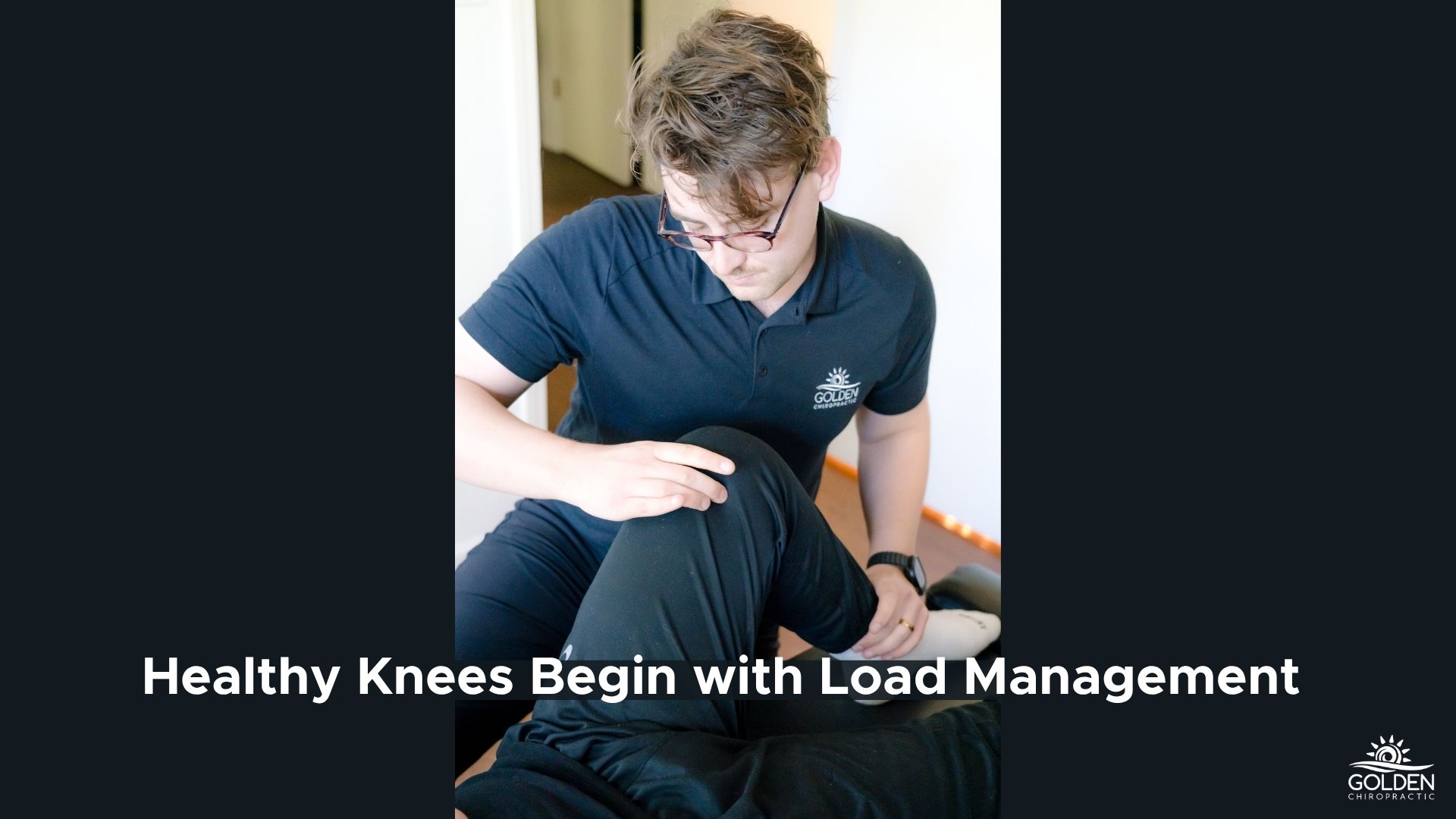
For this patient, we started with myofascial release and chiropractic adjustments to his hips and lower back.
Depending on the case, sometimes I use instrument-assisted soft tissue mobilization (IASTM) to work on the surrounding tissue to help with pain and movement.
After a few initial sessions, this patient’s overall pain decreased.
That gave us more room to work.
Once his pain threshold lowered, we could begin rehabilitation exercises designed to improve the patellar tendon's strength and capacity.
We started light and gradually built his tolerance back up.
That's the bigger goal with patellar tendinopathy: Not simply making your knee feel better today, but helping it become capable of doing more tomorrow.
Are there times when knee pain should be evaluated right away?
Most patellar tendon problems develop gradually. But some symptoms shouldn't be treated as a typical overuse injury.
Seek prompt medical evaluation if your knee pain begins with:
- A sudden pop or snap
- A tearing sensation
- Significant swelling or bruising
- Inability to actively straighten your knee
- Displacement of the kneecap
- A hot, red, significantly swollen knee
- Fever or other signs of systemic illness
Those symptoms can indicate something more serious than routine tendon irritation.
If any of the above has happened, get medical help as soon as possible.
Our goal is to get you out of pain and back into life.
Ultimately, we don't want you spending your whole day thinking about your knee.
We want you walking downstairs without bracing yourself.
Hiking without worrying about the downhill.
Squatting, running, jumping, training, and participating in your sport with ease.
You don’t have to constantly wonder whether you're making things worse. Come see us instead.
We don’t just offer pain relief.
We help you rebuild your knee's capacity so you can confidently get back to the activities you enjoy.
Our chiropractors in Aptos can evaluate your knee and how the surrounding muscles and joints are functioning.
We’ll also help manage your pain while guiding you through an appropriate return to activity.
You don't have to stop doing what you love.
You just need help taking measured steps toward rebuilding strength and flexibility.
Book online and we can get started with that.